Youngkin's last budget constricted by mandatory spending to Medicaid and education
Published in News & Features
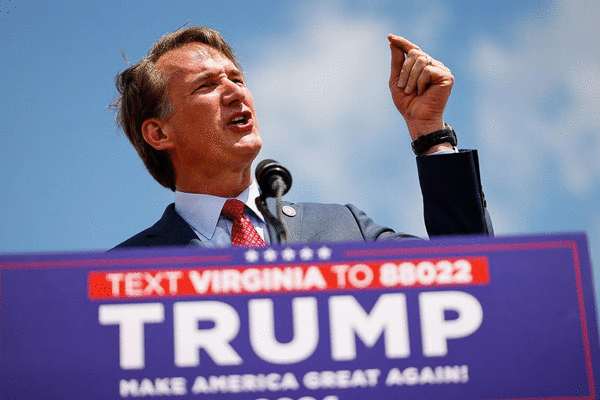
RICHMOND — Gov. Glenn Youngkin presented his final budget plan to the General Assembly’s money committee’s Wednesday. It’s a less ambitious proposal than in years past, which historically included the elimination of the car tax.
But the magnitude of meeting the commonwealth’s spending obligations next year was such that it crowded out other budget priorities. Mandatory spending measures include an increase of $2.6 billion in critical Medicaid investments over three years and $543.8 million for recalibrating the state’s education funding formula.
The Republican governor’s budget forecasts a 3% annual revenue growth. That’s conservative compared to the actual revenue growth over the course of his term, Youngkin said. But he said even if the economy experiences slower growth, the budget is sufficient to pay for the state’s mandatory expenses and provide $730 million in tax relief as well as 2% pay increases for educators and state employees. The total general fund budget over the biennium comes out to $72 billion.
“Virginia’s stronger than she’s ever been, with revenue growth that has come out at 8% over the last four years, which is 60% higher than it was for the decade,” said Youngkin, who leaves office next month. “I think (the forecasted revenue growth) leaves considerable upside for the next administration.”
During the presentation to legislators, Youngkin also took aim at Democrats who campaigned on the harm they said federal cuts inflicted to Virginia’s economy.
“This high rate of revenue growth should continue as long as Virginia stays with the demonstrated winning formula,” he said. “Despite the predictions for financial calamity that was predicted by many this year, and I have to say, many in this room, financial calamity has not happened, and Virginia again is running a significant surplus.”
But Democrats say that’s an overly optimistic outlook.
“I think the governor’s expectations for the economy and the budget are out of touch with reality,” Sen. Majority Leader Scott Surovell told reporters. “We’re going to have to figure out how to pay for about $2 billion in Medicaid losses, about $1 billion to do K-12 requirements, another billion or two dollars of expenses and revenue cuts that have been inflicted on us by the federal government that aren’t really accounted for there.”
Other topline items in Youngkin’s proposal include $730 million in tax relief, including making permanent the increased standard deduction and the refundability of the earned income tax credit, as well as mimicking some of the measures in the federal spending budget bill, HR1, that made permanent President Donald Trump’s 2017-era tax cuts. Those conformity measures include a phased-in elimination of tax on tips and car loan interest.
“Normally, we conform to what the federal government does to us,” Surovell said. “However, this year, conforming would cost us about $1 billion a year, which is a lot of money. We have to figure out if we could afford it.”
The two-year budget lawmakers adopt next year is unlikely to closely resemble Youngkin’s proposed spending plan. That’s because Youngkin leaves office next month and Gov.-elect Abigail Spanberger, a Democrat, will be sworn in. Youngkin, like all Virginia governors, is prohibited from serving a second consecutive term. Democrats swept Virginia elections in November, taking control of the top state elected offices and picking up additional seats in the House of Delegates. They will hold control of the General Assembly and have the votes to make drastic changes that fit their priorities.
“I think you’re going to see some major surgery done to this budget once we get our hands on it,” Surovell said.
Youngkin’s budget bill also calls for tax reform that would change its tax collection methodology from cost of performance to market-based sourcing, meaning that companies would be taxed where based on where customers are located as opposed to where the business provides service.
The budget also includes $1 billion for pay increases for teachers, support staff and state employees, including a 2% bonus in fiscal 2026 and a 2% salary increase in fiscal years 2027 and 2028. An additional $328 million would go to pollution reduction efforts. And, $2 billion, which includes $890 million from the state’s general fund and $1.1 billion in authorized debt, would go towards new construction projects. That includes resuming projects at Virginia universities that Youngkin paused back in May to prepare for economic uncertainty caused by federal policy.
Senate Democrats did note some key policies, including the teacher pay increases and funding for the Supplemental Nutrition Assistance Program (SNAP).
“The Governor’s introduced budget makes some essential investments that Senate Democrats support,” the caucus said in a statement. “Protecting Medicaid, strengthening SNAP, and raising pay for our teachers and school staff are meaningful steps that reflect priorities we’ve long championed. These are the kinds of investments that help Virginia grow stronger and build an economy that works for everyone.”
Earlier this week, Youngkin also proposed the inclusion of $50 million in the budget to fund a three-year child welfare strategy that overhauls Child Protective Services intake process and increases pay for social workers.
In Virginia, the budget operates on a biennial basis — in odd years, the governor proposes a bill at the end of the year that dictates the commonwealth’s budget for the next two fiscal years, which start July 1. In even years, they propose a slate of amendments to that bill. That means Gov.-elect Abigail Spanberger inherits Youngkin’s budget proposal. The legislature, which is controlled by Democrats, will vote to amend the budget, and Spanberger will sign off on it.
“As the next Governor of Virginia, I look forward to working with the General Assembly to lower costs for Virginia families, invest in Virginia’s public schools, and protect access to critical healthcare services,” Spanberger said in a statement. “My team and I are already digging through the details of this proposal, and I look forward to working with Chair Lucas, Chair Torian, and their committees to make sure that Virginia’s best days are ahead.”
Youngkin enjoined Democrats not to adopt policies he said would harm Virginia’s economy, like rejoining the Regional Greenhouse Gas Initiative or repealing the state’s “right to work” law.
“Pro business policies attract jobs … Right now Virginia is roaring and she needs to stay that way,” he said.
________
©2025 The Virginian-Pilot. Visit at pilotonline.com. Distributed by Tribune Content Agency, LLC.





Comments