US 'blockade' of oil tankers likely not enough to push Maduro out, experts warn
Published in News & Features
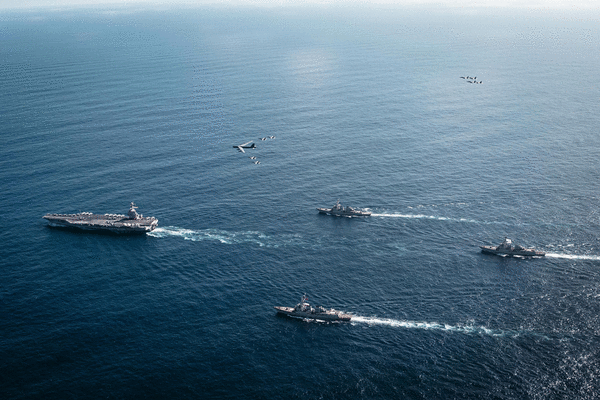
A “blockade” of tankers under sanctions that are carrying Venezuelan oil, as President Donald Trump warned this week, will ratchet up pressure on Nicolás Maduro’s regime, but won’t likely be enough to push him out, experts told the Miami Herald.
In a social media post on Tuesday evening, Trump announced “A TOTAL AND COMPLETE BLOCKADE OF ALL SANCTIONED OIL TANKERS going into, and out of, Venezuela.”
Venezuela, he said, is “completely surrounded by the largest Armada ever assembled in the History of South America. It will only get bigger,” he added, until “they return to the United States of America all the Oil, Land, and other Assets that they previously stole from us,” likely a reference to the expropriation of American oil companies under the late Hugo Chavez.
The post has sown confusion, and Democrats in Congress immediately picked up on Trump’s choice of words. U.S. Rep. Joaquin Castro, who is leading an effort to pass a War Powers Resolution bill that would block hostilities against Venezuela without congressional authorization, said on X that a naval blockade would constitute an act of war that would need Congress’s approval.
The White House has not clarified the wording in the president’s threat of a blockade. Still, experts believe Trump likely referred to the seizure of additional sanctioned oil tankers, a legal enforcement action similar to the U.S. Coast Guard’s seizure of the oil supertanker Skipper off the coast of Venezuela last week. That is different than an actual naval blockade that would entail U.S. warships stopping all sea traffic entering and leaving Venezuela.
“What the President is doing is not a blockade, even though the President called it a blockade,” said Evan Ellis, a research professor of Latin American studies at the U.S. Army War College Strategic Studies Institute. “I think what President Trump intended to do was to put all of those oil tankers on notice that if you were subject to sanctions, like happened with the Skipper, you are subject to seizure. It was unfortunate they called it a blockade, because technically a blockade, as representative Castro said, is an act of war.”
Ellis and other experts believe that the seizures of tankers won’t be enough to convince Maduro, or the Cuban security apparatus around him, that Trump is serious about pursuing regime change.
The sanctions squeeze creates further headaches for Maduro, but “I don’t think it’s enough to get him to leave,” said Ryan Berg, director of the Americas Program and head of the Future of Venezuela Initiative at the Center for Strategic and International Studies. “I think that Maduro thinks that Trump is bluffing until the day that Trump actually launches the first missile strike.”
Berg believes the Cubans might be advising Maduro to “just play for time because the Americans will lose interest. And they might be right, because once we roll into 2026, the entire focus is going to be on affordability, the midterm elections, things that move us away from the idea of kinetic strikes on Venezuela.”
Even if that’s the case, the Maduro regime seems alarmed by the escalation. In a phone call Wednesday, Maduro “alerted” the United Nations’ Secretary António Guterres “about the escalation of threats against Venezuela and their serious implications for regional peace,” the Venezuelan regime said in a statement.
In a press conference on Wednesday Farhan Haq, the deputy spokesman for Guterres, said the U.N. chief is following the situation closely.
“We are looking at what the applicable laws are at this stage, and we’re studying the situation, but certainly, parties have to abide by the U.N. Charter,” he said.
The Cuban government, which would have been the beneficiary of part of the oil that was seized on the Skipper and is believed to be supporting Maduro with personal protection and counterintelligence, also reacted to Trump´s announcement. The island’s leader, Miguel Díaz-Canel, called the threat of a “naval blockade ... a criminal act of piracy.”
There are more than 900 sanctioned ships that are part of a larger global so-called dark fleet involved in skirting sanctions against Iran, Venezuela, Cuba and other countries. More than 30 ships on which the U.S. has imposed sanctions for their involvement in carrying oil from Venezuela, Iran and Russia are engaged in the trade of Venezuelan oil.
Already, the seizure of the Skipper is having a significant deterrent effect, said Jorge Jraissati, a Venezuelan activist and the president of the Washington-based Economic Inclusion Group, a nonprofit policy group that is working on plans to rebuild Venezuela after a future democratic transition.
“Right now, Venezuela oil is trading $21 less than the Brent Crude,” the primary global oil benchmark, he said. “There is a chilling effect, and many shipments will likely not happen because people will be afraid their tankers will be seized by the U.S. Every tanker of roughly two million barrels is worth $100 million, so there’s a significant risk for people doing this.”
Jraissati believes that cutting Venezuela’s oil revenue will have “a considerable impact on Maduro,” even more than on the Venezuelan public, a concern some experts have raised.
“Most of this money really doesn’t go to the population,” he said. “In Venezuela, 50% of people are in extreme poverty, which means that people don’t make more than $3 per day, and 80% of people are in poverty, which means that they don’t make more than $10 per day. So the situation is already quite dramatic.”
Ellis believes that Maduro would still have sufficient revenue from other illegal activities and that taking incremental actions might end in failure, as it did during the first Trump administration’s push to dislodge Maduro through a maximum-pressure sanctions campaign.
“If you choose to just put on more incremental pressure, you get the worst of both worlds,” he said. “You get a high probability of increased, massive migration outflows, just like it happened in 2020 without the prospect of regime change. If you choose to do a decisive action and get it over with, you have a brief or more manageable risk. You get destabilization, because the Russians and others are going to try to sabotage the refineries, but at least then you get a semi-assured transition to democracy and a chance to fix it.
“The dilemma is, which risk will President Trump take?” he added.
Part of the problem, Ellis said, is the administration’s insistence that the massive deployment of U.S. warships in the Caribbean is just about counternarcotics. While the recent designation of Maduro as the head of a foreign terrorist organization, the Cartel de los Soles, provides some legal justification to act, “if you say it’s all about drugs, it’s harder to make the case for trying to push for a change in government.”
There’s also pushback from some followers of Trump and commentators from both the right and the left who have suggested that U.S. military action in Venezuela might have results similar to the protracted military engagements in Iraq or Afghanistan.
“I believe it to be disingenuous, and it’s being promoted by people who know that the American public doesn’t necessarily know a lot about Venezuela or about Afghanistan and Iraq, either, other than they were complicated, divisive and costly conflicts,” said Eric Farnsworth, a senior associate with the Americas Program at the Center for Strategic and International Studies. “To the extent that you want to prevent U.S. action on Venezuela, one of the best ways to do that is to try to convince the American public that it would be just like Afghanistan.”
But after moving so many assets to the Caribbean, the largest military deployment in the region in decades, which includes the strike group of warships led by the aircraft carrier USS Gerald R. Ford, U.S. “prestige” is on the line, Farnsworth said.
“Moving the Ford to the region was one of those moments where we crossed the Rubicon,” Berg said. “To move it out of the region without doing anything. I think it would be a huge hit to U.S. credibility.”
“No transition is risk-free,” he added. “But the risks inherent in this transition are less risky than the status quo of a full-blown criminal regime in the heart of South America.”
_____
(Miami Herald staff writer Jacqueline Charles contributed to this story.)
_____
©2025 Miami Herald. Visit miamiherald.com. Distributed by Tribune Content Agency, LLC.





Comments