Colorado lawmakers take another stab at spinning off the state's workers' comp carrier
Published in Business News
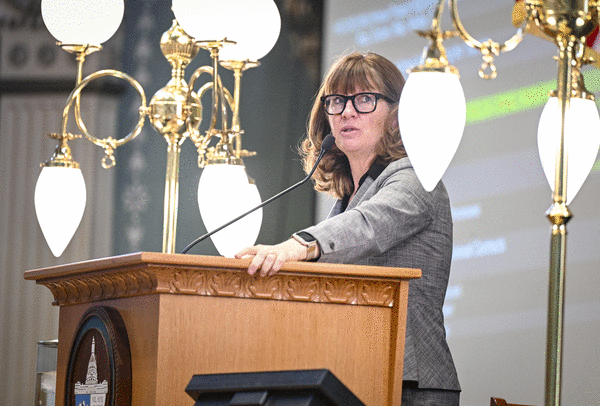
After several failed attempts to spin off Pinnacol Assurance through the state budget, supporters are now taking a different route — pushing new legislation that would lay the groundwork to convert Colorado’s workers’ comp program to a private entity.
Speaker Julie McCluskie, a Dillon Democrat, said she planned to introduce a bill in the next week or two that would allow Pinnacol’s board to disaffiliate the quasi-independent agency from the state.
The move has long been a goal pursued by Gov. Jared Polis as a way to generate money to close state budget deficits. He’s included the spin-off in his last two budget proposals, and it’s been part of broader conversations for years before that. But each of those attempts has been rebuffed by the legislature.
Those conversations have been nixed by concerns about what privatizing Pinnacol would mean for workers and employers who rely on it for insurance coverage — and, indeed, if the state could even tap into money from the spin-off.
Pinnacol serves as the workers’ compensation insurer of last resort for the state, meaning it provides coverage to industries typically considered too high risk for traditional insurance pools. But its unique setup means Pinnacol faces a competitive disadvantage — chiefly, an inability to operate across state lines in an increasingly national employment market — that threatens its long-term viability, backers of privatizing the agency say.
To sweeten the pot, supporters are eyeing a potential $300 million payday for the state that could help repair some of the cuts being proposed to fill a $1.5 billion deficit in the state budget for the next fiscal year.
“I do think that it makes sense for Pinnacol, certainly, and their fiscal health and ability to thrive,” McCluskie said of the plan, while previewing the bill recently. She added: “It’s our responsibility that we leave no stone unturned, that we look at every possible action that we can take to shore up the state’s fiscal health.”
According to a draft of the bill, the proposal would give Pinnacol’s board the option to change its legal status from that of a political subdivision of the state to that of a mutual insurance company by June 30, 2027. Pinnacol would need to pay the state at least $300 million to make the switch, which would be constituted as a property sale under the bill.
That one-time money would be earmarked under the legislation for blunting some of the cuts to Medicaid providers, housing and education that lawmakers are now considering.
The bill text highlights Pinnacol’s dwindling market share — from about 60% in 2015 to 49% in 2024 — as part of the reason to make the switch now.
Spinning off the insurer would allow Pinnacol to grow its market share to include businesses that operate across state lines. As a state subdivision, Pinnacol can serve only Colorado companies.
Under the proposal, Pinnacol or its successor agency would still serve as the state’s insurer of last resort for three more years. After that, the state would open up that contract to bidding by Pinnacol and other insurance agencies to assume that role in the long term, with tax incentives as a lure.
Eric Maruyama, a spokesperson for Polis, said in a statement Monday that the governor appreciated the proposal put together by McCluskie and other lawmakers. Sen. Judy Amabile, a Boulder Democrat, and Rep. Rick Taggart, a Grand Junction Republican, joined her in drafting the bill. Both serve on the Joint Budget Committee.
“Without action, we are limiting Pinnacol’s ability to keep costs down for the workers and employers they serve,” Maruyama said. He added that the draft bill would “help restore cuts from this year’s budget and set up the state’s workers’ compensation market for long-term success.”
But those opposed to the spin-off worry about what it would mean for the long-term viability of workers’ compensation insurance in the state.
Stephanie Tucker, a workers’ compensation attorney and president of the Workers’ Compensation Education Association, said her group remained “staunchly opposed” to the idea of privatizing Pinnacol.
Pinnacol is the largest workers’ compensation insurer in the state by a wide margin, Tucker said. Without state backing, she said, the legislation would leave open the question of what company would serve as the insurer of last resort — or if any company would want to.
“Without (Pinnacol), and without somebody effectively acting as the insurer of last resort, we’re all in big trouble — injured workers and businesses alike,” Tucker said.
She also raised the specter of lawsuits bogging down any spin-off. Companies enter into specific contracts with Pinnacol, and using money that’s earmarked for coverage and rebates to buy out the state wouldn’t fit into that, she said.
The bill’s path through the legislature, once it’s introduced, also isn’t clear.
Labor organizations share Tucker’s concerns, and some Democrats in the majority have been wary enough of past proposals to stop their introduction.
Pinnacol, meanwhile, has also raised questions about finding the right dollar figure and making sure any transition is seamless.
“Pinnacol remains deeply committed to a modernization path that protects Colorado’s employers and secures the highest quality care for injured workers,” Pinnacol spokesperson Liz Johnson said in a statement. “As we review the proposed legislation, our priority is ensuring that any transition reflects a fair assessment of the state’s financial stake in Pinnacol while maintaining the stability and premium affordability our members rely on.”
©2026 MediaNews Group, Inc. Visit at denverpost.com. Distributed by Tribune Content Agency, LLC.








Comments