How the landmark verdict against Meta and YouTube could hit their businesses
Published in Business News
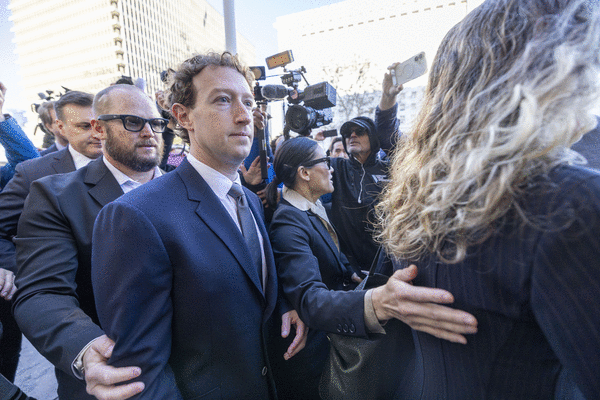
LOS ANGELES — A Los Angeles jury dealt a blow to social media giants Meta and YouTube this week when it found that the platforms were negligent for designing addictive features that harmed the mental health of a California woman.
Both companies plan to appeal, but the ruling has ignited uncertainty around the tech companies' future and sparked questions about the potential fallout.
The seven-week trial kicked off in February, featuring testimony from Meta and YouTube executives.
Kaley G.M., a 20-year-old Chico woman, sued the platforms in 2023, alleging that using social media at a young age led to her mental health problems such as body dysmorphia and depression. She also sued TikTok and Santa Monica-based Snap and those companies settled ahead of the trial.
Lawyers representing the woman argued that the platforms hook in young users with features such as infinite scrolling, autoplaying videos and beauty filters.
People use social media to keep up with their friends and family, but teens can also feel inadequate, sad or anxious when they compare themselves to a curated version of other people's lives online. They're also spending a lot of time watching a seemingly endless amount of short videos.
A jury determined that Meta was 70% responsible for Kaley's harms and YouTube was 30% responsible. They awarded her a total of $6 million. The ruling came shortly after a New Mexico jury found Meta liable for $375 million in damages after the state Attorney General Raúl Torrez alleged the platform's features enabled predators and pedophiles to exploit children.
"These verdicts mark an unsurprising breaking point. Negative sentiment toward social media has been building for years, and now it's finally boiled over," said Mike Proulx, a director at Forrester, a market research company.
How have the companies reacted to the verdict?
Meta and Google, which owns YouTube, said they disagreed with the ruling and plan to appeal.
"This case misunderstands YouTube, which is a responsibly built streaming platform, not a social media site," said Jose Castañeda, a Google spokesman, in a statement.
Meta spokesman Andy Stone posted the company's statement on social media site X.
"Teen mental health is profoundly complex and cannot be linked to a single app. We will continue to defend ourselves vigorously as every case is different, and we remain confident in our record of protecting teens online," the statement said.
Tech companies have been responding to mental health concerns, rolling out new parental controls so parents can keep track of their children's screen time and moderating harmful content. Instagram and YouTube have versions of their apps meant for young people.
Some child advocacy groups and lawmakers, though, say these changes aren't enough.
Will this affect Meta and YouTube's business?
The ruling could affect how much money YouTube's parent company, Alphabet, and Meta earn as they spend more on legal battles. While they make billions of dollars from advertising, investors are wary about higher expenses. The companies are already spending billions of dollars on artificial intelligence and developing new hardware such as smartglasses.
On Thursday, Meta's stock fell more than 7% to $549 per share. Alphabet saw its share price drop more than 2% to roughly $280.
In 2025, Meta's annual revenue grew 22% from the previous year to $200.97 billion.
Last year, YouTube's annual revenue surpassed more than $60 billion. Both Google and Meta have been laying off workers as they spend more on AI.
The ongoing backlash hasn't stopped tech companies from growing their users.
A majority of U.S. teens use YouTube, TikTok, Instagram and Snapchat, according to a 2025 Pew Research Center survey. More than 3.5 billion people use one of Meta's products, which include Instagram and Facebook.
What about the development of new features and AI tools?
Social media has continued to change over the years as companies double down on short videos and AI chatbots.
Mental health concerns have only heightened as AI chatbots that respond to questions and generate content become more popular. Families have sued OpenAI, Character.AI and Google after their loved ones who used chatbots killed themselves.
Some analysts remain skeptical that Meta and YouTube would make drastic changes to their products because they've weathered crises before.
"Neither Meta nor YouTube is going to do anything different until a court orders them to, or there's a significant drop in user or advertiser use," said Max Willens, Principal Analyst at eMarketer.
Other analysts said legal risks could also affect how tech companies develop new AI-powered products and features.
"It's likely that tech firms will now face increased scrutiny over the design of their platforms, which should drive more thoughtful inclusion of features that foster healthier interactions and safeguard mental health," said Andrew Frank, an analyst with Gartner for Marketing Leaders.
At the very least, the verdicts serve as a "dire warning about how we handle the next wave of technology," Proulx said.
"If we're still struggling to put effective guardrails around social media after nearly two decades, we're far from prepared for the growing harms of AI, which is moving faster, scaling wider, and embedding itself far deeper into people's lives," he said.
———
(Times staff writer Sonja Sharp contributed to this report.)
———
©2026 Los Angeles Times. Visit latimes.com. Distributed by Tribune Content Agency, LLC.









Comments