Aaron Brown: By all measures, productivity is sky-high. So why do we feel so left out?
Published in Business News
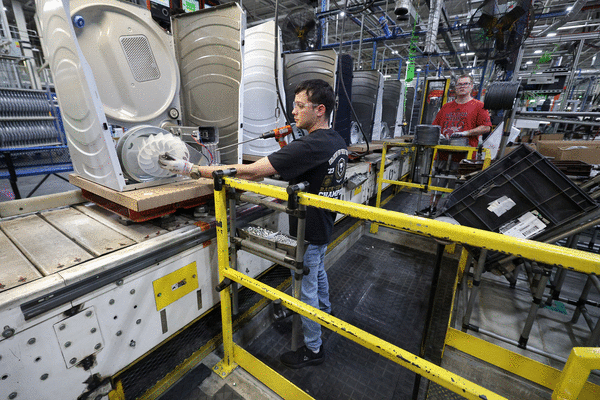
Like many Americans born in the 20th century, I measure each day by my productivity. My children laugh and call me a “try-hard.” But you should try hard, I say. They laugh again. They might be smarter than me.
If you’re not sure what “productivity” means, your boss certainly does. In economic terms, productivity measures how effectively labor, capital and materials become goods and services.
The rise of America’s global economic strength over the past century and a half was defined by our race for more productivity. But don’t look for a finish line; you won’t find one. Other nations have since become rampantly productive, especially in places where money does more work than hands. Today, technology like artificial intelligence stands ready to launch human productivity into the stratosphere.
That is, if we can still call it “human” productivity. Arguably, we cannot. This disconnection between productivity and humanity threatens everything we care about.
First of all, here’s a shock. By the measures that once counted, the economy is good, or at least was until the war in Iran. The jobless rate, while ticking slowly upward, remains relatively low. Wages are historically high. Inflation, while higher than optimal, is mostly constrained from its post-COVID spike. Despite near-constant uncertainty, including chaotic trade policy and the aforementioned war, the stock market seems impervious to collapse (though we are certainly testing that theory in recent weeks).
Even so, polls generally show that Americans don’t feel the economy is good. That’s because, for most, it really isn’t. The yawning gap between rich and poor manifests in economic anxiety around housing and seemingly permanent price increases for groceries and goods. Important sectors of the economy, like manufacturing, seem stuck, which is why few new jobs are being created. Americans are saving less and report less optimism about their financial futures.
Despite popular pessimism, American companies report enormous gains in productivity. In fact, productivity growth is as high now as in any decade since World War II. And yet, it’s hard to properly identify where all this productivity is coming from.
In a compelling March 7 essay, “Something Feels Weird About This Economy,” economist Noah Smith argues this phenomenon could be a mix of artificial intelligence adoption raising productivity but also spurring hiring uncertainty. A data-center construction boom is driving some of the euphoria. The sudden removal of many low-wage foreign workers from the job market may have juiced the numbers, too, though Smith argues that could be a bad thing in the long run.
Regardless, we’re making new billionaires faster than at any time in our history. Productivity is really good for billionaires, which is why billions of dollars of investments seem to so easily land in AI’s virtual pocket. AI investment’s promise of more productivity, and more billions, is irresistible.
There’s a concerning trend here that will require significant social and political realignment, if only to account for the massive change caused by AI and other tech advances.
This goes beyond simple criticisms of capitalism. I remember my friend’s mom telling us not to drink too much Kool-Aid when we were kids, then watching my friend literally snort the pink powder after she left. This did not turn out well. Well, in propping up this misalignment of economic priorities, America is snorting that which should not be snorted.
When Charlie Chaplin made his classic comedy “Modern Times” in 1936, he played to audiences terrified of losing their jobs and humanity to soulless mechanization. These factory machines would literally grind men with fearsome gears — hilariously, of course.
Mike Judge’s 1999 film “Office Space” satirized so-called white-collar work. Here, some office buddies lamented the mundane life of cubicles and spreadsheets, embarking on a thrilling heist to give their life a new purpose.
Sixty-three years separate these two films. The year 2062 would be next in the sequence. What movie could we imagine satirizing “work” at that point?
I can imagine a story we would today call science fiction. Few people have jobs. Most live in substandard housing, plugged into a virtual world of entertainment and distraction. Perhaps a visionary has an idea to plant a seed in the dark soil found beyond the data center complex. Before long, he’s “invented” farming and his friends join in. Soon, a small town might pop up with a blacksmith shop and saloon, maybe even a forbidden newspaper. It’s a joyful purpose, new to them, remembered only by the people in senior assisted-living facilities, if at all.
Productivity without humanity casts our state and our communities into an empty void that even our greatest experts in technology do not understand.
Productivity without humanity fosters resentment from those left behind, a group that will rapidly become a large majority of us. This is true whether we are rural or urban, liberal or conservative, or too overwhelmed to think much about politics. None of that matters if there is no hope for work, prosperity or purpose.
The kids talk about “grind culture,” one in which people “hustle” for the life they want. Most people don’t really do this, however, because people need demand and capital to start businesses, not just LinkedIn buzzwords.
Indeed, our economy thrives when we each spend our days productively. For that word to matter, however, we need to do something meaningful with our lives. That is where a humanity-based public policy begins. That is true productivity.
____
Aaron Brown is a columnist for the Minnesota Star Tribune Editorial Board.
©2026 The Minnesota Star Tribune. Visit at startribune.com. Distributed by Tribune Content Agency, LLC.









Comments