Michael Hiltzik: Trump's love affair with coal won't save the industry from extinction
Published in Business News
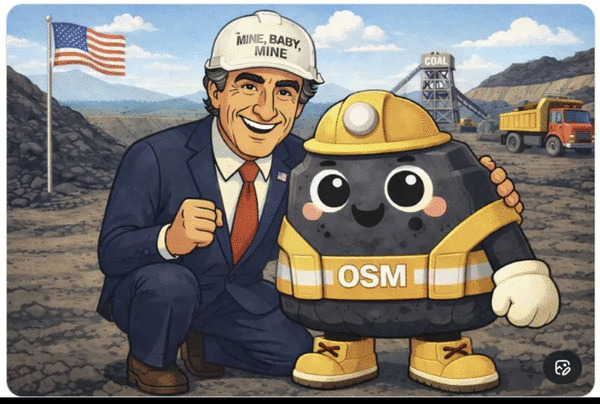
He's a cute little fella, decked out in his reflective vest, hard hat and work boots, with his big eyes and a fixed grin.
Meet "Coalie," who joins the army of official and semiofficial mascots making government and commercial pitches go down easier for you and me, like Smokey the Bear, McGruff the Crime Dog and Franklin the Fair Housing Fox.
Coalie, however, isn't selling forest fire prevention or personal safety awareness or fair housing regulations. He's trying to sell Americans on the dirtiest fuel in the energy arsenal — and one of the most expensive. Basically, this mascot is carrying the flag for a quixotic battle to save a dying industry.
President Trump has long promoted a revival of the coal industry as one of his signature policies. He took the first steps in that direction during his first term, but has stepped up the effort during the current term. He seldom refers to coal without the modifiers "clean" and "beautiful."
We should quibble with those adjectives. In April, Trump signed a sheaf of executive orders that would allow aging coal plants slated for retirement to remain open, allow coal mining on federal lands and grant exemptions for coal plants from government mandates to reduce emissions of mercury, benzene, arsenic and other toxins.
"We're ending Joe Biden's war on beautiful, clean coal," Trump declared at the White House signing ceremony on April 8. "We're putting you back to work," he told miners at the ceremony.
In February, Trump collected a trophy naming him the "Undisputed Champion of Beautiful Clean Coal" from Jim Grech, the chief executive officer of Peabody Energy, a major coal producer that had filed for bankruptcy in 2016, not long after its executives predicted that a 20-year "supercycle" in coal use was just getting underway. Instead, the company had lost nearly $4 billion from 2012 through 2015. It emerged from bankruptcy in 2017.
The principal cheerleaders for Trump's coal revival are Lee Zeldin, administrator of the Environmental Protection Agency, and Interior Secretary Doug Burgum. The latter is the sponsor of Coalie, which Burgum repurposed from its original role as a promoter of government-funded coal site rehabilitation, which is, you know, a public benefit. Burgum appears to have been saddled with the task of making coal-burning and its dismal emissions look just as good.
"We were always told that coal is the dirtiest fuel," Fox Business host Stuart Varney observed to Burgum during an on-air interview last month. "Is that no longer true?"
Burgum came to the defense of coal and its capacity to generate carbon dioxide, that virulent greenhouse gas, as though that's an admirable quality.
"Is CO2 a pollutant, or is it something that helps grass grow?" he responded. "We know it does the latter for sure, because plants absorb CO2 and exude oxygen.... If you have a CO2-enhanced greenhouse, you can grow plants 30 or 40 percent faster."
There isn't much to say about this, other than his first point is akin to saying, yes, you can drown in a swimming pool but you also need water to drink, so building fences to keep toddlers from falling into the water would be a waste of money. And also, it's one thing to have a greenhouse to grow tomatoes in, but quite another to live inside a global greenhouse.
As for Zeldin, he's a carrier of the blame-the-Dems phage. "The Obama and Biden administrations deliberately tried to regulate coal out of existence," he said at the April 8 ceremony. "We are committed to supporting all forms of energy, including clean beautiful coal."
The administration's efforts to revive the coal industry are undermined by published government findings.
The Energy Information Administration, a unit of the Department of Energy, lists among coal-generated pollutants sulfur dioxide, "which contributes to acid rain and respiratory illnesses"; nitrogen oxides, which foster smog and also respiratory illnesses; particulates, which contribute to smog and lung disease; carbon dioxide, the leading greenhouse gas producing global warming; and mercury and other heavy metals, which can cause neurological and developmental damage in humans.
The EIA reckoned that in 2022, emissions from burning coal accounted for about 20% of U.S. energy-related CO2 emissions and 55% of CO2 emissions from the electric power industry. That's quite a roster of side effects, like the small print at the end of drug company TV commercials.
In much of the country coal isn't needed. That's true for California, as my former colleague Sammy Roth points out. The day before Thanksgiving last year, the Los Angeles Department of Water and Power shut down the last coal-fired plant directly serving California. (It's located in Utah, as it happens.) There were no blackouts, no brownouts. No one noticed it was missing.
Meanwhile, Roth reports, electricity from California's large-scale solar farms rose by 17% in 2025 from 2024.
Trump's "clean coal" labeling demonstrates either that he doesn't know anything about coal or is in the grip of industry mythmaking. "Clean coal" was a spavined effort by the coal industry to rebrand its product as something benign, through a technology that convertedcoal to gas and sequestered carbon dioxide underground.
It never really took hold. In 2017, as I reported, Southern Co. pulled the plug on the flagship plant of this effort, a coal gasification factory it had erected in eastern Mississippi. The plant had racked up years of cost overruns and technical breakdowns. Originally expected to cost less than $3 billion, its projected cost had soared to $7.5 billion. Southern took a $3.4-billion loss on the project.
Southern had calculated that the plant would be economical if the price of natural gas rose above $5 per million BTUs (British thermal units). For a brief shining moment, that looked like a good bet, as gas prices rose to nearly $10 per million BTUs in mid-2022. But they promptly came back down. Currently, the spot price is about $3. The Mississippi plant now exclusively burns natural gas.
The fact is, however, that Biden had nothing significant to do with the decline of coal. Economics did most of the damage, abetted by environmental concerns.
The major obstacle facing a coal revival is the price of competing energy sources, especially natural gas. The cost of renewables such as solar and wind power has also come down sharply, underscoring the poor economics of coal-fired generation. Americans and others in the developed world also have exploited efficiencies in power use that have allowed major economies to grow without creating commensurate demands for electrical power.
Another factor is China. During its economic takeoff at the turn of this century, China became the world's largest coal importer. U.S. companies, assuming the trend would be irreversible, made multibillion-dollar investments in the first decades of the 2000s to buy up rivals at premium prices. They began planning new shipping terminals on the West Coast to bring western coal to China.
Starting in 2013, however, China's growth began to stall and the government's altered its policies to move away from the heavy industries that generated most of the country's coal demand. China also moved into renewables. "Between 2011 and 2015," according to the Center on Global Energy Policy at Columbia, "China added more solar capacity to the grid than any other country and almost as much wind capacity as the rest of the world combined."
For all that Trump blames Democratic policies for coal's decline, "more than half of the decline in US coal company revenue between 2011 and 2015 had little to do with domestic market conditions or domestic regulations," the Columbia researchers observed, "but was rather due to a dramatic slowdown in Chinese demand."
The end of the China boom coincided with ebbing demand for coal in the U.S., where the shale oil boom produced a surge in natural gas supplies and a steep fall in its prices.
Coal has simply been unable to keep up with changes in U.S. energy. Coal accounts for about 16% of electrical generation in the U.S., about even with nuclear power and renewables, down from 48.5% in 2007. Its role at major utilities has declined from 1.35 billion megawatt-hours in 2015 to 737 million MWh in 2025, a fall of 45%. The slack has been taken up by natural gas and solar and wind power.
Trump's fixation about coal is another of his whims of iron, like tariffs. He poses as if he's the savior of a valiant craft, but with the exception of the extremely coal-centric states Wyoming and West Virginia coal mining scarcely registers as a component of the U.S. economy. Coal accounts for less than two-hundredths of gross domestic product. In 1950, coal mining provided 350,000 jobs. By 1975 it was 175,000, and today it's 39,500.
Or maybe he thinks attacking renewables and promoting coal is a way to own the libs, because all that solar and wind stuff is a woke leftist plot. You know, solar and wind power are just other forms of DEI.
The question really is how to help the coal zone, its workers and business owners and families, weather the inevitable. Pretending to restore the coal zone to the employment conditions of the1950s, or even the 1980s, isn't an honest way to go about it. Turning the clock back can't be done. That's good, because it shouldn't be done.
If Trump really cared about the miners he would make sure that the job and retraining programs that are always promised to workers actually materialize. He'd stop letting the coal industry delay regulatory enforcements. And he wouldn't have let DOGE dismantle an important mine safety agency.
That's where the drill meets the coalface, so to speak. All else is just palaver.
©2026 Los Angeles Times. Visit at latimes.com. Distributed by Tribune Content Agency, LLC.









Comments