Spam's global reach helps Hormel overcome price-shocked US shoppers
Published in Business News
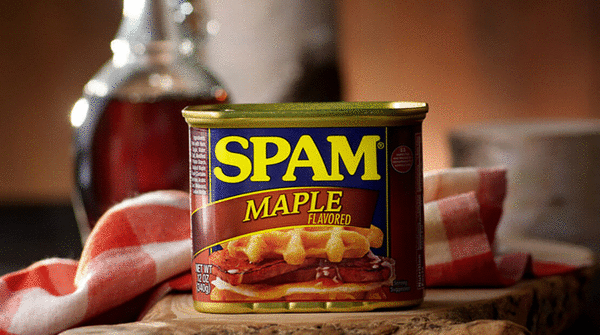
Food companies continue to struggle at the grocery store, where U.S. consumers are balking at high prices amid inflation.
Hormel Foods has a workaround, though: Spam.
Popularity of the iconic canned meat overseas is helping to lift Hormel’s international profit, which is driving growth for the company in an otherwise middling first quarter.
During World War II, Hormel — headquartered in Austin, Minnesota — sent millions of cans of Spam to Allied soldiers, which kicked off the meat’s popularity in Asian and Pacific Island cuisines. Now the ham is a grocery store staple in Hawaii and roughly 50 countries, whose geography overlaps with the Pacific theater during the war.
In the financial quarter that ended Jan. 25, global Spam shipments increased, Hormel President John Ghingo said. Inspired by the product’s popularity in Asia, where Spam is an ingredient in various “sushi formats,” he said, the company is selling Spam musubi with help from grocery stores like Kroger.
Musubi is a Hawaiian dish of soy sauce-seasoned Spam on rice wrapped in seaweed. Partnering with grocers to make and sell it started on the West Coast but is now reaching across the U.S., executives have said.
Ghingo said Hormel continues to support Spam as one of its “priority brands” through marketing and innovation.
“If you kind of look at the roots of Spam — the foundation of Spam — it is convenient, it is affordable, it’s versatile and it’s protein. And that checks a lot of boxes for consumers,” Ghingo said.
Hormel reported relatively steady profit and sales despite low consumer sentiment continuing to punish big food companies. Slim Jim-maker Conagra Brands reported decreasing sales in late December, and Golden Valley’s General Mills recently lowered its sales outlook as middle- and lower-income consumers reduce spending.
Discontinuing some private-label nut items, expected consumer balking at price increases and turbulence for Skippy peanut butter hampered the number of Hormel’s retail sales.
At a time when food companies are embracing protein, sluggish sales of peanut butter — a quintessential workout food — raise some concerns.
Consumer pullback from Skippy began when competitors pursued “aggressive promotional pricing activity” at the end of the previous fiscal year, Ghingo said.
After a fire at a Skippy peanut butter plant in Arkansas in the fall, executives de-emphasized customer programs and promotions supporting the brand.
“We wanted to make sure we protected our everyday distribution and used the supply we had to fill the shelves,” Ghingo said, adding the disruption has resulted in some short-term effects on revenue.
Still, Ghingo said Skippy offers Hormel a “tremendous” opportunity as a “substantial, satiating protein-based snack.” The company is growing distribution for its extra-protein Skippy, he added.
The protein craze is boosting Hormel’s Jennie-O ground turkey, which experienced double-digit growth in the quarter, Ghingo added. Consumers, he said are looking for lean protein, which ground turkey provides. It is also a versatile ingredient in the kitchen, he added.
The story’s different for the kind of turkey eaten on Thanksgiving. Hormel announced last week it would sell its whole-turkey business.
Interim CEO Jeff Ettinger said this turkey segment is a “high-volatility” and “low-margin” area.
“It was really more a consumer space that is kind of mostly one time a year,” Ettinger said, adding there are fewer opportunities to add value.
Hormel reported adjusted profit per share of 34 cents for the quarter, two pennies ahead of Wall Street analysts’ expectations. Sales of $3.03 billion, which rose when adjusted for some product launches and endings, were slightly below predictions, as the company navigates higher raw material and logistics costs.
Thomas Palmer and other J.P. Morgan analysts said strong profits in Hormel’s food-service segment — selling food to institutions such as schools — helped offset a “shortfall” in its retail segment.
Ghingo said even though consumers are “stretched and strained, they value protein.”
“If we can do the things to protein that help [consumers] in terms of making it easy, convenient, delicious, they will be willing to pay for protein solutions in general,” Ghingo said.
©2026 The Minnesota Star Tribune. Visit at startribune.com. Distributed by Tribune Content Agency, LLC.










Comments