Starbucks CEO makes 1,794 times his average employee. Here's why
Published in Business News
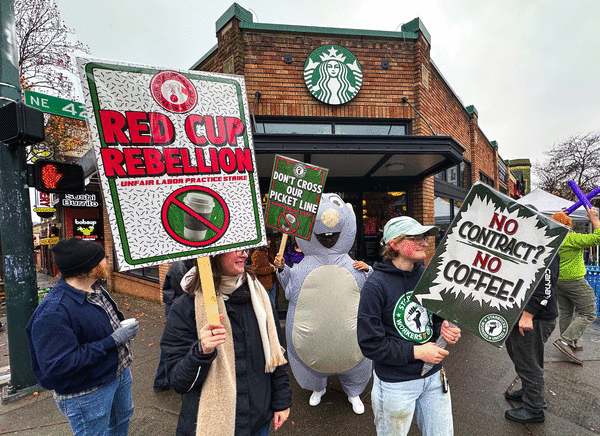
When Michelle Eisen and her fellow baristas organized an upstart union at a Starbucks, she and others were frustrated by the messaging from the top.
It was late 2021 and Starbucks’ then-CEO Kevin Johnson was making the rounds in the media to discuss Starbucks’ stellar year amid the pandemic. The company reported that it ended its fiscal year with a record quarterly revenue of $8.1 billion. Johnson's compensation for 2021 was about $20.4 million.
“We’re hearing them talk about how much money they’re bringing in and we’re not able to pay our bills,” said Eisen, who left Starbucks in May 2025 after 15 years with the company. “The math was not adding up.”
Starbucks is now on its third CEO since Johnson stepped down in 2022. Eisen said the company’s messaging on pay has remains the same.
Starbucks, like most of Seattle’s corporate titans, has taken fire from workers and observers for the yawning pay gap between executives and rank-and-file employees. An upswing in executive compensation has largely been driven by a rising stock market — even struggling Starbucks saw a boost in its share price in late 2024 through early 2025 — as CEO pay gets more closely tied to stock awards.
That swing makes a bad look worse for Seattle’s large, publicly traded companies, which have to report pay disparity levels contrasting CEO compensation with that earned by the median employee. For retail employers that rely on low-wage workers like Starbucks and Amazon, the ratios show an extraordinarily wide gap in 2025.
Washington CEO pay skyrockets
Flagging sales hit Starbucks in early 2024, though the company remained profitable. To generate some enthusiasm for Starbucks’ future, the company in the fall of 2024 snapped up Brian Niccol, who was credited with Chipotle’s explosive growth during the pandemic years. The company provided Niccol a compensation package for the last four months of 2024 valued at more than $96 million. It was one of the biggest compensation packages among publicly traded companies that year.
Most of Niccol’s compensation is derived from stock awards that Starbucks used to replace those Chipotle would’ve provided him if he’d stayed. But for Eisen and the rest of the union, who are fighting for higher wages, the almost $100 million pay package for Niccol in 2024 to lead a company that ultimately relies on near-minimum wage workers exposed a disparity between the top and bottom of the company
CEO pay for publicly traded companies has peaked each year since the pandemic, a trend that doesn’t look likely to change. Workers’ wages at these companies are also growing, just not always as fast as their bosses’.
Niccol's pay in 2025 was significantly lower than the year before, according to a regulatory filing in late January. But the Starbucks chief's compensation for the year was almost $31 million, making him one of the higher paid CEOs in Washington state.
Kyle Eastman, of Seattle-based Compensation Advisory Partners, has been helping corporate boards craft executive pay packages for 15 years. Though stock-based pay has always been part of compensation, he’s seen growing stock awards become commonplace.
“It’s considered best practice to have compensation aligned with shareholder interest,” he said. “But the proportion of equity in the pay mix has certainly increased.”
Most workers’ wages have risen over the past decade after years of stagnation, though inflation — the rising cost of goods and services — has ramped up as well.
CEO pay packages draw the ire of politicians and unions. Starbucks Workers United, the independent union representing the company’s baristas, has repeatedly criticized Niccol’s pay, drawing support from progressives like U.S. Rep. Pramila Jayapal, D-Seattle, and U.S. Sen. Bernie Sanders.
When Starbucks Workers United went on strike in November, Sanders posted in solidarity on social media. He also took a swipe at Niccol.
“When a corporation can pay $96 million to its CEO for just four months of work, it can afford to pay its workers a living wage and decent benefits,” Sanders wrote on the social media platform X.
In Washington, the annual mean wage for all occupations grew by 51% between 2015 and 2024, according to data from the Bureau of Labor Statistics. For Washington-based CEOs, the annual mean wage in that time grew by 82%.
Starbucks and Amazon contributed to those higher wages. When Amazon was led by its founder Jeff Bezos, the company made a push for a $15 minimum wage in 2018. Starbucks employees also received a flat 2% pay bump in 2025; the company says when benefits like health insurance and college tuition are included, the average barista receives $30 an hour in compensation.
But Eisen, who still works with the Starbucks Workers United union after organizing workers in Buffalo, N.Y., takes issue Starbucks' wage-growth claims. Many benefits only kick in when employees meet a certain amount of hours that eludes part-time employees, meaning many employees aren’t costing the company $30 an hour.
The union is demanding higher wages and more guaranteed hours for baristas, who often work part-time. Eisen says their proposal pencils out to a $75 million expense for Starbucks, a figure the union explicitly notes is less than what Niccol’s pay package was in his first four months on the job.
Flat salaries, doubled pay
The pay figures disclosed for the chiefs of the country’s top public companies are eye-popping.
Microsoft CEO Satya Nadella’s latest total annual compensation was almost $100 million.
Even outgoing top executives can take home a sizable chunk of change. Former T-Mobile CEO John Legere had a $137 million golden parachute in 2020. Shown the door amid a crisis, former Boeing CEO Dave Calhoun walked away from the company in 2024 with a compensation package worth about $45 million.
Most of that pay is stock awards issued to executives in lieu of cash. The size of those awards has increased dramatically in recent years, even as CEO salaries remain relatively flat.
Nadella’s compensation, for example, ballooned over the past few years as Microsoft’s share price soars. His salary has been steady at $2.5 million since 2020, but his overall compensation in that time has gone from $44.3 million to $96.5 million.
Out of Niccol’s $95.8 million compensation package in 2024, more than $90 million of it was in stock-based pay.
The packages don’t come out of thin air, and designing them is more science than art, according to Eastman. Corporate boards review the compensation of CEOs at similar companies and collect them into peer groups to find the right offer.
Other factors come in as well. If an executive forfeited pay at a company to take a job, the new company may lump in what they gave up. In its offer letter to Niccol, Starbucks said his stock awards were to make up for what he lost by leaving Chipotle.
Among that pay package, Starbucks also offered Niccol the chance to work from Newport Beach, Calif., with the use of company aircraft to travel to the Seattle offices. Niccol was seen as Starbucks’ potential savior amid declining sales and a poor market performance. Eisen said his “Back to Starbucks” plan to revive the company’s roots was touted to employees as the reason he was essential.
“The belief that these CEOs can make or break a company is deeply rooted in how we think of corporate structures,” said Abhinav Gupta, a finance professor at the University of Washington. “If a company says ‘He’s our last hope to turn things around,’ then the number to get him is going to go up. That’s how it goes.”
‘A blunt metric’
The most direct comparison between a CEO’s pay and the median workers is disclosed annually by companies using a fairly simple formula. Under federal regulatory guidelines, companies pinpoint the median worker salary and divide the CEO’s annual compensation from that to get the ratio.
But it may also not be telling us the full story.
As tech companies dominate stock market indexes and swell compensation packages, the ratio measuring the difference between a CEO’s pay and the workforce’s pay is becoming less useful. Top executives are paid much differently than the typical worker.
CEO pay ratios provide a useful look at the structure of corporate America, says Gupta. They confirm notions of corporate hierarchy, that great pay disparities lie between the bottom of companies and the top.
“The median pay tells us far more about the nature of the work at a company and whether the employees are viewed as essential or expendable,” Gupta said. “But it’s not a good metric for wages.”
Companies that rely on operations or retail workers have a wide range of pay scales. Amazon’s pay ratio is decided by all employees, but those working in warehouses almost always earn far less than those working in the company’s corporate offices.
Because of the compensation package Starbucks offered Niccol, the company had a CEO pay to median worker ratio of 6,666 to 1 in 2024. That fell to 1,794 to 1 in 2025. Under his predecessor in 2023, the ratio was 1,028 to 1.
Starbucks’ figure is an outlier in a sea of high ratios. Most publicly traded companies in Washington have ratios between 200 to 1 and 300 to 1.
Another anomaly is Amazon CEO Andy Jassy.
On paper, the company’s CEO pay ratio was a low 43 to 1, despite the median Amazon worker making a little more than $37,000. From 2022 through 2024, Jassy’s compensation was less than $1.6 million a year.
That’s because Amazon frontloaded Jassy’s compensation when he succeeded founder Jeff Bezos as CEO in 2021. Jassy received a stock award, then valued at $212 million, that would vest over the following decade. Even though he didn’t have immediate access to all of that money, the company’s pay ratio in 2021 was 6,474 to 1.
“It’s another limitation of the CEO pay ratio,” Eastman said. “It’d be more effective to show it annualized, show the value of his stock stretched out over those years. But it’s a blunt metric.”
Amazon has started showing the actual received compensation for its troika of CEOs, which includes Jassy, Amazon Web Services chief Matt Garman and Amazon’s retail CEO Doug Herrington. In 2024, Jassy’s take-home pay was $40.1 million. Amazon’s retail CEO brought home $22.4 million and the cloud division CEO made $11.9 million.
For people like Eastman who consult on compensation packages, pay ratios aren’t much of a factor.
Early on, critics of disclosing pay ratios argued it might lead to corporate boards chasing a lower number and driving down CEO pay even if it wasn't as transparent a figure as it appeared to be. But Eastman says he doesn’t see that occurring.
CEO pay, Eastman said, is ultimately decided by a similar factor for the average workers’ pay: market rate.
“Boards are not ignoring the pay ratio, they want to be informed,” Eastman said. “But our job is to make sure they’re informed of the limitations. Companies are not setting pay levels based on their pay ratios.”
©2026 The Seattle Times. Visit seattletimes.com. Distributed by Tribune Content Agency, LLC.






Comments