McDonald's faces class action fraud lawsuit over lack of 'actual rib meat' in McRib
Published in Business News
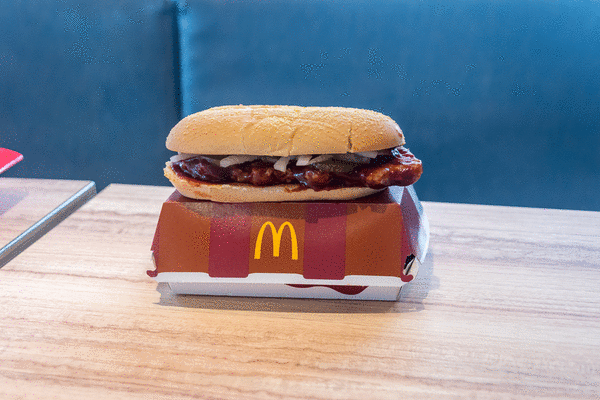
When McDonald’s brought back its cult-favorite McRib to Chicago and a handful of other markets for a limited run in November, it set off a media frenzy and a mad dash to the Golden Arches for fans of the sporadic sandwich.
But the return of the McRib also precipitated a class action lawsuit alleging that the sandwich – so beloved it has a crowdsourced website with a locator map for potential sightings – is really a fraudulent mystery meat smothered in barbecue sauce.
The lawsuit, filed last month in Chicago federal court, makes no bones about what it alleges to be false and deceptive marketing of the McRib.
“Despite its name and distinctive rib-like shape, it does not actually contain any pork rib meat,” the lawsuit states. “McDonald’s knew these facts would be material to reasonable consumers but still chose not to disclose them.”
There are four lead plaintiffs in the class action lawsuit, including Dorien Baker of Chicago. All were “misled” by McDonald’s through alleged deceptive marketing into buying the McRib, paying a premium price and believing it had a “meaningful quantity” of pork rib meat, according to the lawsuit.
Instead, the lawsuit alleges those consumers received a “lower-quality restructured meat product” essentially from parts unknown, including “pork shoulder, heart, tripe, and scalded stomach.”
McDonald’s issued a statement Monday disputing the lawsuit, saying it “distorts the facts and the claims are meritless.” The Chicago-based chain also defended the quality of its McRib sandwich.
“Our fan-favorite McRib sandwich is made with 100% pork sourced from farmers and suppliers across the U.S. – there are no hearts, tripe or scalded stomach used in the McRib patty as falsely alleged in this lawsuit,” McDonald’s said in the statement. “We’ve always been transparent about our ingredients so guests can make the right choice for them.”
Thiago Coelho, a Los Angeles attorney who brought the class action lawsuit, said in an email Monday that Baker “will not be making any comments” regarding his McRib experiences during the ongoing litigation.
The McRib was introduced in 1981, two years ahead of Chicken McNuggets, and has come on and off the menu at seemingly random intervals ever since.
In November, McDonald’s announced that the McRib was coming back for a limited time at select restaurants in Chicago, Miami, Dallas, St. Louis, Atlanta, Seattle and Los Angeles.
The return lit up the internet at sites like the McRib Locator, which touts it has been reporting hot-mapped sightings of the “tasty yet elusive sandwich” since 2008.
On its website, McDonald’s describes the sandwich in a much more appetizing manner than the lawsuit, saying the McRib “starts with seasoned boneless pork dipped in a tangy BBQ sauce, topped with slivered onions and tangy pickles, all served on a toasted homestyle bun.”
The ingredients for the McRib Pork Patty are listed as: pork, water, salt, dextrose and rosemary extract. The entire sandwich comes in at 520 calories, according to the McDonald’s website.
The lawsuit is seeking an order enjoining McDonald’s from “further deceptive naming, marketing and advertising practices with respect to the McRib,” as well as undisclosed damages.
Whether the litigation determines if a McRib needs to be made of rib meat, remains to be seen. But it also begs the age-old question posed by comedians and consumers alike as to what part of the chicken the McNuggets come from.
We do know the Chicken McNuggets recipe was tweaked over the years, becoming all white-meat in 2003 and eliminating artificial preservatives and colors in 2016, according to the McDonald’s website.
And while the McRib will have its day in court, there is some broader nutritional good news for the burger giant in the latest dietary guidelines released by the federal government.
Unveiled last week by Health Secretary Robert F. Kennedy Jr., red meat and cheese are now at the top of an inverted food pyramid, along with vegetables. For millions of consumers, the new guidance ostensibly makes the Big Mac – two all-beef patties, special sauce, lettuce, cheese, pickles, onions on a sesame seed bun – something akin to health food.
_____
©2026 Chicago Tribune. Visit at chicagotribune.com. Distributed by Tribune Content Agency, LLC.










Comments